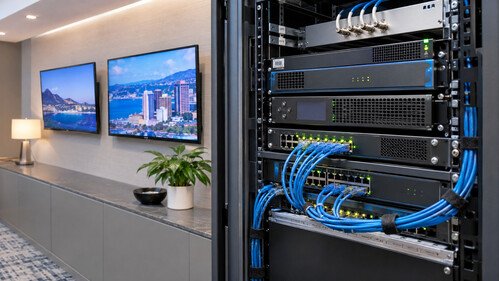
Modern television distribution is no longer limited to traditional coaxial cable systems. With the growing popularity of Internet Protocol Television (IPTV), organizations can now deliver live television channels through standard Ethernet networks, simplifying infrastructure management and providing greater flexibility. Distributing local TV channels over an Ethernet network is an efficient solution for hotels, hospitals, apartment buildings, educational institutions, corporate facilities, and other environments where multiple televisions need access to the same programming. Instead of installing separate coaxial cable connections for every television, IPTV distribution allows operators to transmit television signals as digital data packets through existing network infrastructure. This approach offers several advantages, including centralized management, scalable channel distribution, and integration with modern network technologies. However, implementing a reliable IPTV distribution system requires appropriate equipment, sufficient network capacity, and proper configuration. In this guide, we explain how to distribute local TV channels over an Ethernet network, the equipment required, the technologies involved, and the best practices for building a stable and efficient television distribution system.
What Is IPTV Distribution Over Ethernet?
IPTV distribution over Ethernet refers to the delivery of television channels using Internet Protocol (IP) across a local area network (LAN). Unlike conventional cable television systems, which transport RF signals over coaxial cables, IPTV converts or packages television content into IP data streams. These streams travel through Ethernet switches and network cables to compatible receiving devices, such as IPTV set-top boxes, smart televisions, or computers. For example, a hotel can receive local terrestrial television channels through a rooftop antenna, convert them into IPTV streams, and distribute them to hundreds of guest rooms through its internal Ethernet network. Depending on the source and receiving equipment, television channels may be delivered using UDP multicast, RTP multicast, or unicast streaming protocols. Multicast is particularly useful for distributing the same live television channels to numerous viewers simultaneously.
Equipment Required to Distribute Local TV Channels
Building an IPTV television distribution system typically requires several essential components.
1. Television Signal Source
The first step is obtaining the local television channels that will be distributed.
Common sources include:
- DVB-T or DVB-T2 terrestrial television antennas
- DVB-C cable television feeds
- Satellite receivers or professional satellite headends
- Existing IPTV streams from authorized providers
- Local video sources connected through HDMI or SDI encoders
For terrestrial television, a properly installed antenna must receive sufficiently strong and stable signals. Reception quality is important because errors in the original broadcast signal can affect the entire IPTV distribution system.
2. IPTV Gateway or Encoder
An IPTV gateway is one of the most important components of the installation. Its primary function is to receive television signals and convert or repackage them into IP streams. For example, a DVB-T2 to IP gateway receives terrestrial television multiplexes and outputs their programs as IPTV streams. Many professional gateways support multiple television tuners, enabling simultaneous reception of several broadcast multiplexes. Some devices support direct transport stream forwarding without re-encoding, preserving the original broadcast quality. When the source is HDMI or SDI, a dedicated video encoder may be required to compress the signal into H.264 or H.265 before distribution.
3. Managed Ethernet Switches
Ethernet switches transport the television streams from the IPTV gateway to receiving devices. For professional installations, managed Gigabit Ethernet switches are generally recommended. These switches should support important networking capabilities, particularly IGMP snooping, which helps control multicast traffic. Without proper multicast management, IPTV streams may be forwarded unnecessarily to many switch ports, increasing network utilization.
4. IPTV Receivers or Smart TVs
The final component is the receiving equipment. Compatible smart televisions may receive IPTV streams directly through their Ethernet interfaces. Other installations use dedicated IPTV set-top boxes connected to conventional televisions through HDMI. Computers with compatible software players can also receive multicast or unicast IPTV streams. The selected receivers must support the streaming protocol, video codecs, audio formats, and channel management method used by the system.
Step-by-Step Guide to Distributing Local TV Channels Over Ethernet
Step 1: Receive Local Television Signals
Begin by identifying which television channels are available in your location. For terrestrial broadcasting, install a suitable DVB-T or DVB-T2 antenna and connect it to the IPTV gateway. The antenna should be positioned to provide stable reception of the required multiplexes. The gateway scans the available frequencies and detects television programs. Depending on the country and broadcasting standard, a single multiplex can contain multiple television and radio services.
Step 2: Convert Broadcast Signals into IP Streams
Once the gateway receives the television signals, configure it to output the selected programs as IP streams. Professional gateways commonly support MPEG Transport Stream over UDP or RTP. Each television channel can be assigned a unique multicast IP address and UDP port.
For example:
Channel
Multicast Address
UDP Port
Local TV 1
239.10.10.1
5000
Local TV 2
239.10.10.2
5000
Local TV 3
239.10.10.3
5000
Local TV 4
239.10.10.4
5000
These addresses are illustrative examples for a private IPTV network. The addresses allow compatible receivers to subscribe to individual television streams. In systems supporting service filtering, operators can distribute selected programs instead of forwarding entire broadcast multiplexes.
Step 3: Configure the Ethernet Network
The Ethernet network must be configured to handle continuous video traffic. For smaller installations, a dedicated Gigabit Ethernet network may provide sufficient capacity. Larger deployments should consider higher-capacity uplinks, network segmentation, and managed switching infrastructure. IGMP snooping should be enabled on switches handling multicast traffic. An appropriate IGMP querier must also be present in the VLAN to maintain multicast group membership information. For deployments spanning multiple network subnets, multicast routing may be required. Separating IPTV traffic into a dedicated VLAN can improve traffic organization and simplify troubleshooting.
Step 4: Connect Receiving Devices
Connect IPTV-compatible televisions or set-top boxes to the Ethernet network. Each receiver must be configured to access the correct IPTV streams. Some IPTV systems use channel playlists, commonly in M3U format, while others use middleware platforms that provide electronic program guides, channel management, and user interfaces.
A basic M3U playlist might contain entries such as:
#EXTM3U
#EXTINF:-1,Local TV 1
udp://@239.10.10.1:5000
#EXTINF:-1,Local TV 2
udp://@239.10.10.2:5000
Compatible IPTV players can use this information to access the corresponding multicast streams.
Step 5: Test and Optimize the System
After connecting the receivers, verify that every channel plays correctly. Check video quality, audio synchronization, channel switching, and network utilization. It is also important to monitor packet loss and other network errors, particularly when several televisions are operating simultaneously. A properly configured IPTV system should deliver stable television streams without unnecessary interruptions.
Multicast vs. Unicast IPTV Distribution
Choosing the correct transmission method is essential for efficient television distribution.
Multicast IPTV
Multicast enables multiple receivers to access the same stream without requiring the source to send an independent copy to each viewer. For example, if one television channel requires 8 Mbps of bandwidth, 100 viewers watching that channel can receive it through a single multicast stream across shared network links, subject to the network topology. This makes multicast particularly efficient for large installations.
Unicast IPTV
Unicast establishes a separate stream between the source and each receiving device. If 100 viewers independently receive an 8 Mbps channel through unicast, the source-facing network link may require approximately 800 Mbps of video traffic, excluding protocol overhead. Unicast can be useful when multicast is unavailable or when content must be delivered individually. However, multicast is usually the more bandwidth-efficient choice for distributing the same live channels across a large managed LAN.
Benefits of Ethernet-Based TV Distribution
Reduced Cabling Requirements
One of the main advantages of IPTV distribution is the ability to use existing Ethernet infrastructure. Organizations with installed network cabling may avoid building an entirely separate coaxial television distribution system. This can reduce installation complexity and simplify future upgrades.
Centralized Management
IPTV gateways and management platforms allow administrators to configure channel lists, monitor incoming signals, and control distribution settings from a central location. This is particularly valuable in buildings with hundreds of receiving devices.
High Video Quality
IPTV gateways that forward original broadcast transport streams without transcoding can preserve the video and audio quality of the source transmission. When transcoding is required, operators can configure suitable compression settings according to the available bandwidth and device compatibility.
Flexible System Expansion
Additional receiving devices can be added to the network, provided that switching capacity, port availability, multicast configuration, and licensing requirements are sufficient. Operators can also expand the system by integrating additional broadcast tuners, IPTV gateways, or video encoders.
Common IPTV Distribution Challenges
Despite its advantages, Ethernet-based TV distribution requires careful planning. Network congestion may occur when multiple high-bitrate streams share insufficient uplink capacity. Incorrect IGMP configurations can lead to excessive multicast forwarding or interrupted television streams. Compatibility issues may arise when receivers do not support the selected video codec or streaming protocol. Signal reception problems can also affect quality before the content reaches the Ethernet network. To minimize these risks, operators should use professional equipment, plan bandwidth requirements carefully, and monitor network performance. For commercial installations, redundant power supplies, backup signal sources, and reliable networking equipment can further improve service availability.
Where Ethernet TV Distribution Is Most Useful
IPTV distribution is especially suitable for facilities requiring centralized delivery of local television programming. Hotels can distribute terrestrial channels to guest rooms without relying on separate satellite or cable receivers for every television. Hospitals can provide television services to patient rooms using existing network connections. Universities and schools can distribute educational content and local broadcasting channels across classrooms and common areas. Corporate facilities can use the same infrastructure for television programming, internal announcements, and compatible information channels. Residential buildings can also benefit from centralized reception and IP distribution, particularly when Ethernet cabling is already available. Distributing local TV channels over an Ethernet network is a practical solution for modern television installations that require flexibility, scalability, and centralized management. By combining television reception equipment, IPTV gateways, managed Ethernet switches, and compatible receiving devices, organizations can distribute local terrestrial, cable, or other authorized television sources across an IP network. Multicast technology makes it possible to deliver the same live television streams to numerous receivers while minimizing unnecessary bandwidth consumption. Successful implementation depends on proper signal reception, network configuration, receiver compatibility, and continuous performance monitoring. For hotels, hospitals, educational institutions, commercial buildings, and residential complexes, Ethernet-based IPTV distribution offers an efficient alternative to traditional television cabling. As IP networking and broadcasting technologies continue to develop, integrating local television channels into Ethernet infrastructure will remain an important option for building flexible and reliable digital television systems.